

When selecting a rifle scope, the adjustment system plays a major role in how you calculate, dial, and correct your shots. We have designed this MOA vs MRAD scope adjustment guide to simplify the comparison, explaining what each system means, how adjustments translate at distance, and why certain shooters prefer one over the other.
While both MOA and MRAD scope adjustments are precise and widely used, they approach measurement from different perspectives. This influences everything from range estimation to real-time shot correction. For new shooters, the choice often feels technical, while for experienced marksmen, it comes down to speed, consistency, and familiarity.
What are MOA and MRAD Scope Adjustments?
MOA and MRAD are angular measurement systems used in rifle scopes to make precise elevation and windage adjustments. Instead of measuring movement in inches or centimeters directly, rifle scopes use angles to ensure adjustments remain accurate at any distance.
MOA (Minute of Angle)
MOA is based on degrees, with one minute of angle equal to 1/60th of a degree. At 100 yards, 1 MOA moves the point of impact approximately 1inch. Most MOA scopes adjust in ¼-MOA clicks, meaning each click shifts the point of impact about 0.26 inches at 100 yards. Hunters and recreational shooters commonly use MOA because it aligns well with inch-based measurements.
MRAD (Milliradian)
MRAD, also known as mil, is based on the metric system and radians. One MRAD equals 1/1000 of a radian and moves the point of impact 10 centimeters at 100 meters (or about 3.6 inches at 100 yards). MRAD scopes typically adjust in 0.1-mil clicks, providing simple, decimal-based corrections that are fast to calculate. This system is widely preferred in long-range shooting, tactical applications, and competitions due to its efficiency and ease of communication.
MOA Adjustments Advantages and Disadvantages
Advantages:
- Familiar system for shooters who think in inches and yards
- Easy to visualize corrections at 100 yards
- Widely available across hunting and sporting rifle scopes
- Fine adjustment increments commonly ¼-MOA clicks
- Well-suited for traditional hunting and recreational shooting
Disadvantages:
- Calculations are slower at long range compared to MRAD
- Fractional math (¼, ½ MOA) may be less intuitive under pressure
- Less commonly used in tactical and competition environments
MRAD Adjustments Advantages and Disadvantages
Advantages:
- Uses a simple decimal system, making calculations fast and intuitive
- Easy to convert reticle holds directly into turret adjustments
- Highly efficient for long-range shooting and precision applications
- Widely adopted in tactical, military, and competition shooting
- 0.1-mil clicks provide a clean, consistent adjustment system
- Simplifies communication between shooter and spotter
Disadvantages:
- Slight learning curve for beginners unfamiliar with metric-based measurements
- Less intuitive for shooters accustomed to inches and yards
Which Type of Shooting is Best for MOA or MRAD?
MOA (Minute of Angle) adjustments are best suited for shooting styles where simplicity, familiarity, and fine precision at moderate distances are priorities. They are effective in the following types of shooting:
- Hunting: MOA works well for typical hunting distances, where adjustments are often made in inches at 100 yards.
- Recreational and Range Shooting: Casual target shooters benefit from MOA’s straightforward inch-based adjustments, making it easy to understand shot placement and dial corrections.
- Short- to Mid-Range Precision Shooting: For distances where corrections are relatively small, MOA’s finer click values allow precise zeroing and consistent accuracy.
- Benchrest and Traditional Target Shooting: Shooters who prioritize exact point-of-impact control often prefer MOA for its precise, incremental adjustments.
MRAD (Mil) adjustments are best suited for:
- Long-Range Precision Shooting. MRAD’s decimal-based system makes it faster to calculate elevation and wind corrections at extended distances, ideal for consistent hits beyond 300 yards.
- PRS and Competitive Shooting. Precision Rifle Series and similar competitions favor MRAD because shooters can quickly dial or hold using simple 0.1-mil increments under time pressure.
- Tactical and Law-Enforcement Applications. Furthermore, MRAD simplifies target corrections and spotter-to-shooter communication, allowing precise, rapid adjustments in dynamic scenarios.
- Military Use. Standardization around mils enables seamless coordination between optics, rangefinders, and ballistic data, improving operational efficiency.
MOA vs MRAD Scope Adjustment Guide: Best MOA Scopes
1) TORIC 30mm FFP 4-20X50 MRAD PRS Scope
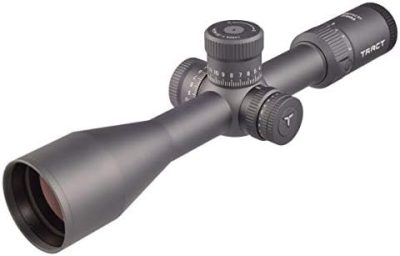
The TORIC 30mm FFP 4-20X50 MRAD PRS scope is the best long-range MOA rifle scope.
As a high-performance riflescope, its first focal plane reticle design places the reticle in front of the erector system and allows accurate use of the MOA reticle for ranging or bullet drop correction at any magnification
Furthermore, the wide 4-20x magnification range provides a perfect balance between close-quarters usability and long-distance precision, while the 50mm objective lens offers excellent light transmission, producing a bright and clear image even in low-light conditions.
Regarding build quality, the rugged construction ensures durability under harsh field conditions. Its 30mm main tube provides ample elevation and windage adjustment for extended-range shooting, and the tactical turrets allow for fast and repeatable zeroing.
Pros
- First focal plane reticle for accurate sub-tensions at all magnifications
- Large 50mm objective lens provides bright, clear imagery
- 30mm tube allows for significant elevation and windage adjustment
- Durable, shockproof, waterproof, and fog-proof construction
- Precision-machined turrets
Cons
- Slightly heavier than comparable scopes
2) Leupold VX-Freedom 1.5-4×20 MOA-Ring Riflescope
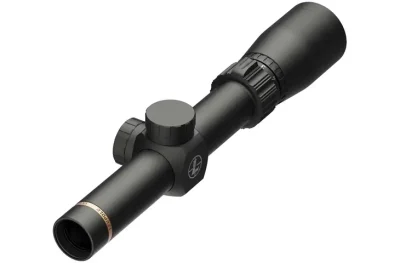
The Leupold VX-Freedom 1.5-4×20 MOA-Ring Riflescope offers a versatile and lightweight solution for hunters and shooters seeking a compact optic without compromising on performance.
Its 1.5-4x magnification range provides a wide field of view at lower magnification, making it ideal for quick target acquisition at close to medium ranges. Furthermore, the MOA reticle allows for precise aiming and adjustment, while the crisp, clear optics deliver bright and sharp images even in low-light conditions.
Built with Leupold’s renowned durability, the scope is shockproof, fog-proof, and waterproof. This ensures reliable performance in harsh environments. Additionally, its lightweight design makes it easy to carry on a variety of rifles, including small-caliber hunting rifles and compact setups.
The scope also stands out for its simplicity and ease of use, with smooth windage and elevation adjustments and an uncomplicated reticle for fast targeting.
Pros
- Lightweight and compact design
- Clear, bright optics with sharp image quality
- Durable: shockproof, fog-proof, and waterproof
- Smooth and precise windage/elevation adjustments
- MOA reticle allows for accurate aiming
Cons
- No illuminated reticle option
- Limited magnification range compared to larger scopes
3) Barska 1.5-6×44 Level Hunting Scope
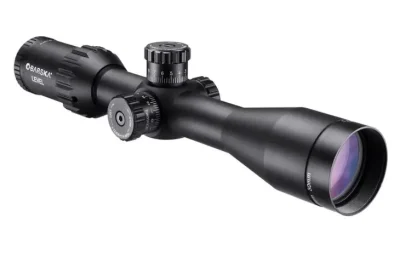
Next, we have the Barska 1.5-6×44 Level Hunting Scope. This versatile optic is designed for hunters seeking flexibility in a compact and reliable package.
With a variable 1.5-6x magnification and a generous 44mm objective lens, it provides bright and clear images in various lighting conditions, from early morning to dusk.
The scope’s etched reticle ensures precision aiming, and its fully multi-coated optics enhance light transmission for sharp target resolution.
Furthermore, the durable construction is shockproof, fog-proof, and waterproof, making it suitable for rugged outdoor environments. Its quick-focus eyepiece and user-friendly adjustments allow hunters to acquire targets smoothly and accurately, whether tracking moving game or taking careful long-range shots.
Overall, it balances affordability with functionality, appealing to both new and seasoned hunters looking for a dependable hunting scope.
Pros
- Variable 1.5-6x magnification for versatile hunting scenarios
- Bright, clear optics with multi-coated lenses
- Durable, shockproof, fog-proof, and waterproof construction
- Etched reticle for precise aiming
- Easy-to-use adjustments and quick-focus eyepiece
Cons
- Lacks illuminated reticle options
4) Nighteagle V4 1.5-6×42
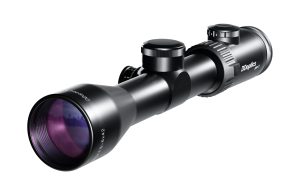
The Nighteagle V4 1.5-6×42 is a versatile riflescope designed for both close- and mid-range shooting.
It offers a clear and sharp image across its entire magnification range. This is thanks to the 42mm objective lens that allows ample light transmission, resulting in bright and crisp visuals even in low-light conditions.
The 1.5-6x zoom range provides flexibility, making it suitable for quick target acquisition at low magnification while still offering enough power for precision shots at longer distances. Additionally, the MOA reticle is well-designed for fast aiming and holds up well under various lighting conditions, providing a balance between accuracy and speed.
Build quality is another standout feature of the Nighteagle V4. The scope is rugged, shock-resistant, and able to withstand heavy recoil. Additionally, the turrets are tactile and precise, allowing for quick and accurate adjustments without losing sight of the target
Pros
- Bright and clear optics even in low-light conditions
- Rugged, shock-resistant construction
- Smooth and precise turret adjustments
- Anti-glare lens coatings for better clarity
Cons
- Limited long-range magnification for extreme distance shooting
MOA vs MRAD Scope Adjustment Guide: Best MRAD Scopes
1) Leupold Mark 5 HD
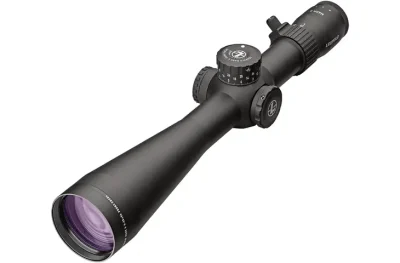
The Leupold Mark 5HD 5–25×56 Rifle Scope is the best MRAD scope. It is engineered for shooters who demand elite-level precision, repeatability, and optical clarity at extended distances.
Built around a robust 35mm tube, this scope offers an exceptional elevation and windage adjustment range, making it ideal for long-range competition, tactical applications, and extreme-distance hunting.
The first focal-plane reticle maintains accurate sub-tensions across the entire magnification range, enabling precise holdovers and ranging at any power setting.
Furthermore, Leupold’s high-definition glass delivers outstanding light transmission, sharp edge-to-edge clarity, and excellent color fidelity, while the large 56mm objective enhances low-light performance without compromising resolution
Despite its professional-grade construction, the Mark 5HD remains impressively lightweight for its class, contributing to better rifle balance and reduced fatigue during extended sessions.
The parallax adjustment is smooth and precise, enabling fine focus control from close to extreme long-range distances. The scope also features tactile, repeatable turrets with a zero-lock system that prevents accidental adjustments while still allowing fast corrections under pressure.
Pros
- Exceptional optical clarity and brightness
- First focal plane MRAD reticle for accurate holdovers at any magnification
- Durable, weatherproof, and shock-resistant construction
- Large 35mm tube allows for greater adjustment range
- Precise, tactile turrets for quick adjustments
- Lightweight for its class
Cons
- Premium price
- The large size requires careful mounting on some rifles
2) Primary Arms Compact PLxC 1-8X24 FFP Rifle Scope
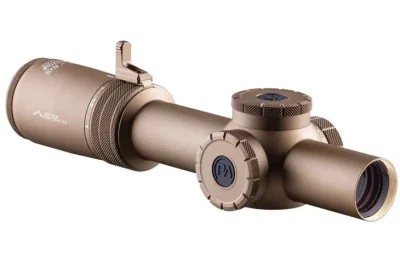
The Primary Arms Compact PLxC 1-8x24mm 30mm Tube Rifle Scope is a first focal plane MRAD scope that offers a versatile and compact solution for shooters seeking a balance between close-quarters speed and long-range precision.
Its reticle design ensures accurate holdovers and ranging at any magnification, making it ideal for dynamic shooting situations. Furthermore, the 1-8x magnification range allows for quick target acquisition at low power while providing enough reach for more distant shots.
Built on a sturdy 30mm main tube, this scope maintains durability and reliable performance even under heavy recoil. Additionally, its compact form factor keeps your rifle balanced and maneuverable.
The scope also brings to the table fully multi-coated lenses for bright, clear images and excellent light transmission, giving you sharp visuals in various lighting conditions.
Pros
- Compact, lightweight design for maneuverability
- First Focal Plane reticle allows accurate holdovers at all magnifications
- High-quality optics with excellent light transmission
- Durable 30mm tube construction withstands heavy recoil
- Smooth, precise turret adjustments
Cons
- Limited maximum magnification compared to larger scopes
- Pricey for budget buyers
Factors to Consider when Choosing MOA vs MRAD Scopes
Shooting Style
Firstly, consider shooting style. Your shooting style influences the choice. Long-range precision shooters often prefer MRAD for metric-based math, while hunters and casual shooters may find MOA easier for yards and inches. Comfort with one system can speed up adjustments.
Reticle and Turret Alignment
Next, reticle and turret alignment matter. Scopes with matching systems, MRAD reticle with MRAD turrets or MOA with MOA, simplify holdovers and range estimation. Avoid mixed systems as they complicate shooting.
Ease of Use
Ease of use and learning are important. MRAD is common in military and tactical setups, while MOA is prevalent in recreational and hunting circles. Using a familiar system reduces errors.
Ammo Consistency
Another factor to weigh is ammo consistency and ballistic performance. MOA scopes tend to be more forgiving with standard hunting calibers at shorter distances, while MRAD scopes simplify calculations for long-range, high-velocity rounds where drop and windage changes are significant. Matching the scope’s measurement system with your typical shooting distances and ammunition type reduces calculation errors and increases confidence
Cost
Furthermore, cost and accessory availability should be considered. MRAD scopes are often pricier, and accessory options vary. Ensuring compatible mounts, rangefinders, or reticles avoids extra hassle.
Versatility
Finally, think about versatility. MRAD suits metric-based distances and varied shooting scenarios, while MOA works well for hunting in yards. Choosing a system that fits both current and future needs ensures long-term usefulness.
MOA vs MRAD Scope Adjustment Guide FAQs
- What is the main difference between MOA and MRAD scopes?
MOA (Minute of Angle) is based on an angular measurement where 1 MOA = 1 inch at 100 yards, whereas MRAD (Milliradian) uses metric units, where 1 MRAD = 10 cm at 100 meters. The choice often comes down to preferred measurement units and shooting style.
- Which system is better for long-range shooting?
MRAD is generally preferred for long-range and tactical shooting because metric-based calculations simplify range estimation and holdovers at extreme distances.
- Are MOA scopes easier for hunting?
Yes, many hunters prefer MOA for typical hunting ranges because the finer adjustment increments make precise shots at short to medium distances more intuitive.
Final Words
Hopefully, you have found this MOA vs MRAD scope adjustment guide informative. Choosing between an MOA and MRAD scope ultimately depends on your experience, shooting style, and long-term goals.
MOA scopes are excellent for precision shooting and hunting at moderate distances, offering fine adjustment control in familiar imperial units. On the other hand, MRAD scopes excel in long-range, tactical, and metric-based applications, providing straightforward calculations for distance and holdovers
Also read: