
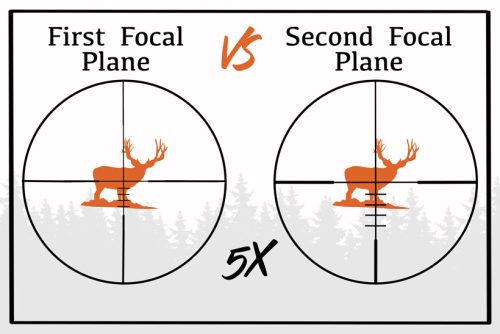
Understanding the difference between First Focal Plane vs Second Focal Plane scopes is essential for anyone looking to get the most out of their rifle optic. While both options are widely used, they offer distinct advantages depending on how and where you shoot.
In this article, we’ll take a closer look at how FFP and SFP scopes work, what sets them apart, and why one may be better suited to your needs than the other. Whether you’re dialing for long-range shots or keeping things simple for hunting and casual shooting, this guide will help you make a more informed choice.
First Focal Plane vs Second Focal Plane Scopes
First Focal Plane scopes have the reticle placed in front of the magnification lenses, so the reticle scales with zoom. This means range-finding and holdovers are accurate at any magnification, making FFP ideal for long-range, tactical, or precision shooting. However, FFP scopes are often pricier, and the reticle can look small at low power and take a bit more practice to use.
On the other hand, Second Focal Plane scopes keep the reticle a fixed size regardless of magnification. This makes it easier to see and faster for quick target acquisition, especially in hunting or general use. The downside, however, is that SFP holdovers and sub-tensions are only accurate at a specific magnification (usually the highest).
Advantages and Disadvantages of First Focal Plane Scopes
Advantages:
- Reticle sub-tensions remain accurate at all magnification levels
- Allows precise holdovers and wind holds without changing zoom
- Ideal for long-range, tactical, and competition shooting
- Better for range estimation using the reticle
- Consistent ballistic calculations across the entire zoom range
Disadvantages:
- Reticle can appear very small at low magnification, reducing visibility
- Typically more expensive than Second Focal Plane scopes
- Less intuitive for beginners
Advantages and Disadvantages of Second Focal Plane Scopes
Advantages:
- Reticle remains the same size at all magnification levels, making it easy to see and use
- Faster target acquisition, especially at low magnification
- Simpler to use for beginners and casual shooters
- Typically more affordable than First Focal Plane scopes
- Versatile for hunting and short- to mid-range shooting
- Cleaner, less cluttered sight picture
Disadvantages
- Reticle holdovers and sub-tensions are only accurate at one specific magnification
- Less suitable for long-range precision and ranging tasks
- Requires dialing magnification to a set power for accurate measurements
Wondering Which One is Best for You?
First Focal Plane (FFP) – This reticle type is the best choice when you need consistent measurements at any magnification and plan to engage targets at variable distances. It is also ideal for:
- Long-range shooters, as precision holds and range estimation remain accurate at all magnifications.
- Tactical and law enforcement with fast, reliable sub-tensions for dynamic engagement distances.
- Competition shooting that requires precise holds and quick adjustments.
- Experienced Shooters: Users comfortable with interpreting reticles at varying zoom levels.
Second Focal Plane (SFP) – A second focal plane reticle is the best choice when ease of use, fast target acquisition, and a clear reticle are priorities, especially at short to medium range. It is also recommended for
- Hunters: Quick target acquisition and simple reticle visuals, especially in low light.
- Beginner Shooters: Second focal plane reticles are easy to use without memorizing reticle sub-tension changes.
- Casual / Plinking Shooters: Simple shooting at consistent or shorter ranges.
- Budget-Conscious Buyers: Typically more affordable while still effective for general use.
Best First Focal Plane vs Second Focal Plane Scopes
1. Vortex Optics Crossfire II Second Focal Plane, 1-inch Tube Riflescopes
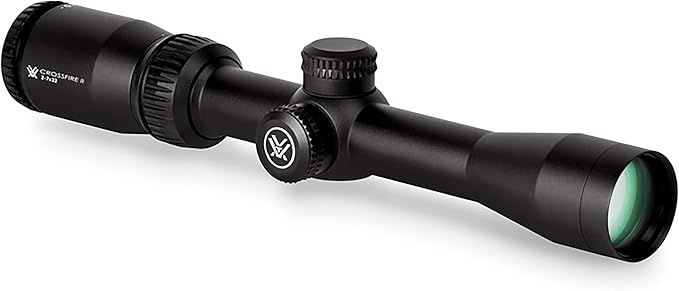
The Vortex Optics Crossfire II Second Focal Plane, 1-inch Tube Riflescopes are the best second focal plane scopes. Available in five configurations, 3-9×40, 3-9×50, 4-12×44, 4-12×40, and 6-18×44, these scopes are reliable and well-rounded to offers excellent performance for the price.
Each scope is built with an aircraft-grade aluminum tube that is both lightweight and rugged, giving confidence that it can take knocks in the field without losing zero.
Furthermore, eye relief is generous, and the fast-focus eyepiece makes getting a crisp reticle quick and painless, even in low light. During daylight shooting, the clarity and contrast from the fully multi-coated lenses are impressive for this price bracket and targets appear sharp with minimal distortion out to the edges of the field of view.
Reticle-wise, the second focal plane reticle stays the same size at all magnification levels, which many shooters find intuitive for quick target engagement and range estimation within the advertised magnification range.
Above all, adjustments for windage and elevation are tactile and precise, with audible clicks that make dialing in holdovers or compensating for wind straightforward.
Pros
- Solid, durable construction
- Clear, bright optics with good edge-to-edge clarity for the price
- Generous eye relief and fast-focus eyepiece for quick reticle acquisition
- Second focal plane reticle remains consistent and easy to use at all magnifications
- Tactile, audible windage and elevation adjustments
- Waterproof, fog-proof, and shockproof for dependable field performance
- Excellent value for hunters and recreational shooters
Cons
- Glass quality, while good, does not match premium high-end scopes
- Reticle illumination is not available on standard models
2) Leupold Mark 5HD 5-25×56 FFP TMR Rifle Scope
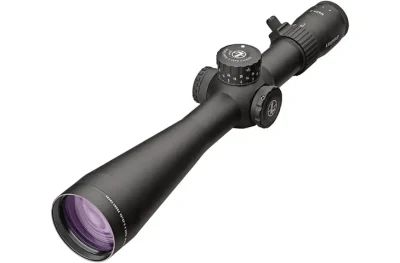
The Leupold Mark 5HD 5-25×56 Rifle Scope is a premium precision optic designed for long-range shooters seeking unmatched clarity and reliability.
With a first focal plane (FFP) reticle, it ensures that holdovers, ranging, and windage adjustments remain accurate at any magnification. Furthermore, the 35mm main tube provides a broader elevation adjustment range, allowing shooters to confidently engage targets at extreme distances.
Optically, Leupold’s advanced lens system delivers exceptional light transmission, producing bright, crisp images even in low-light conditions.
Furthermore, the rugged construction ensures the scope withstands heavy recoil and harsh environments. The scope’s turrets also offer precise, tactile feedback, while the side focus/parallax adjustment enhances target acquisition and reduces eye strain during extended shooting sessions.
Performance-wise, the Mark 5HD stands out for its combination of versatility and durability. Its broad magnification range, paired with a high-quality optical system, allows for clear target identification across diverse shooting environments. Over and above that, the scope is also waterproof, fog-proof, and shockproof, making it a reliable choice in both extreme cold and wet conditions.
Pros
- First focal plane reticle for accurate holdovers at all magnifications
- High-quality optics with excellent light transmission
- 35mm tube allows extensive elevation and windage adjustments
- Rugged, waterproof, fog-proof, and shockproof construction
- Precise, tactile turrets with reliable feedback
- Wide magnification range suitable for varied shooting conditions
Cons
- Larger and heavier than some mid-range scopes, affecting portability
- The advanced features have a learning curve for beginners
3) Zeiss Conquest V4 4-16×50 – ZMOAi-T30 Illum. Reticle
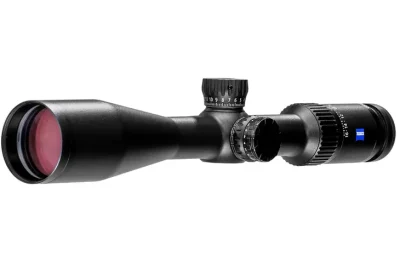
The Zeiss Conquest V4 4-16×50 with the ZMOAi-T30 illuminated reticle is a high-performance rifle scope designed for precision shooting across varying distances.
As one of the best second focal plane scopes, its robust build quality ensures durability in demanding outdoor conditions, while the 4-16x magnification range provides versatile target engagement from close-range to long-range scenarios.
Furthermore, the 50mm objective lens delivers excellent light transmission, offering bright and clear images even in low-light situations such as dawn or dusk.
The ZMOAi-T30 reticle is thoughtfully designed, combining a holdover grid with an illuminated center dot, making it easy to make quick adjustments for windage and elevation without compromising target visibility.
In addition to its optical clarity and reticle functionality, the Conquest V4 excels in user-friendly operation. The turrets provide precise, repeatable adjustments, and the overall ergonomics of the scope allow for smooth focus and magnification changes. It is also waterproof and nitrogen-filled to ensure reliability in all weather conditions.
Pros
- Excellent light transmission and optical clarity
- Versatile 4-16x magnification for various distances
- ZMOAi-T30 illuminated reticle with holdover grid
- Precise and repeatable turret adjustments
- Durable, waterproof, and fog-proof construction
Cons
- Slightly heavier compared to some competing scopes
4) Kahles K318i 3.5-18×50 CCW Rifle Scope
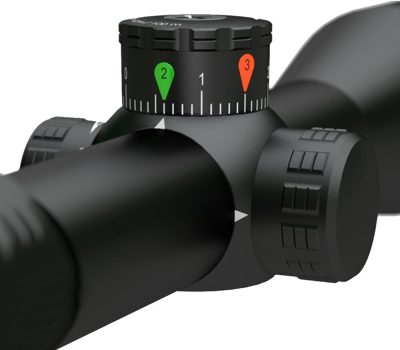
The Kahles K318i 3.5-18×50 CCW Rifle Scope is a high-performance optic that excels in versatility and precision.
Its magnification range of 3.5-18x allows shooters to handle both close and long-range engagements with ease, making it suitable for hunting, tactical, and competitive shooting applications.
To complement the broad zoom range, the 50mm objective lens provides excellent light transmission, ensuring bright, clear images even in low-light conditions such as dawn or dusk. The glass clarity and edge-to-edge sharpness are also impressive, providing a crisp view that enhances target acquisition and situational awareness.
Furthermore, the scope’s CCW (Custom Compact Weight) design keeps it lightweight and balanced, reducing fatigue during extended use while maintaining the durability and ruggedness expected from Kahles optics.
The K318i also shines with its intuitive reticle system and precise adjustment turrets. The CCW reticle is optimized for fast ranging and holdovers, offering a clean, uncluttered sight picture. In addition, the turrets are tactile and reliable, allowing for precise windage and elevation adjustments that are repeatable and smooth.
Pros
- Wide 3.5-18x magnification range for versatility
- Large 50mm objective lens for excellent light transmission
- Lightweight CCW design for improved handling
- Exceptional glass clarity and sharpness
- Precise, tactile adjustment turrets
- Durable and recoil-resistant construction
Cons
- Slightly bulkier than some ultralight scopes
5) CVLIFE EagleFeather LPVO Rifle Scope 1-10x
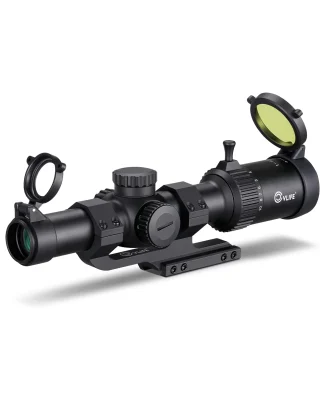
Lastly, we have the CVLIFE EagleFeather LPVO 1-10x rifle scope. This is a versatile optic designed for shooters who need both close-quarters flexibility and long-range precision.
Its 1-10x magnification range allows for rapid target acquisition at low power while providing detailed clarity for distant shots at higher magnifications. Furthermore, the scope features a sleek, lightweight design that doesn’t add unnecessary bulk to your rifle, making it suitable for tactical, hunting, or competition setups.
With fully multi-coated lenses, it delivers bright, sharp images across various lighting conditions, ensuring accurate shots even in low-light environments. Furthermore, the reticle is designed for quick aiming and holds up well under repeated use, making follow-up shots more efficient.
Durability is another standout feature of the EagleFeather LPVO. It is constructed from high-quality materials that make it shockproof, fog-proof, and waterproof.
Above all, the smooth magnification adjustment and precise turrets allow for consistent performance, while its clear optics minimize eye strain over extended shooting sessions.
Pros
- Wide 1-10x magnification range for versatility
- Fully multi-coated lenses for bright, clear images
- Lightweight and compact design
- Shockproof, fog-proof, and waterproof construction
- Smooth magnification and precise turrets
Cons
- Short eye relief at higher magnifications
- Limited reticle illumination options
6) Swarovski Z3 3-10x42mm PLEX Riflescope
Carrying the renowned Swarovski name, the Z3 3-10×42 rifle scope is a premium optic designed for speed and precision in dynamic shooting situations.
Its 3-10x magnification range allows for rapid target acquisition at close range while providing enough zoom for longer shots, making it highly versatile for hunting and tactical use.
Optically, the scope features Swarovski’s renowned optical clarity and edge-to-edge sharpness, delivering bright and crisp images even in low-light conditions. Furthermore, its compact design is lightweight without compromising durability, and the intuitive reticle, combined with a fast-focus eyepiece, ensures quick and accurate aiming under pressure.
Regarding build quality, the high-quality construction is fully waterproof, fog-proof, and shockproof to withstand harsh field conditions and ensure unimpeded performance in all weather condition.
The Z3 also offers advanced customization with precise turrets and adjustable illumination for the reticle, and a consistent eye relief that remains generous throughout the magnification range, reducing fatigue during extended use.
Pros
- Exceptional optical clarity and brightness
- Wide 3-10x magnification for versatility
- Lightweight and compact design
- Fast-focus eyepiece and intuitive reticle
- Durable, waterproof, fog-proof, and shockproof
- Smooth turret adjustments and reticle illumination
Cons
- Premium price point
First Focal Plane vs Second Focal Plane Scopes Buying Guide
Consider the following key factors when choosing between first focal plane vs second focal plane scopes:
Reticle Scaling and Range Estimation
In FFP scopes, the reticle scales with magnification, keeping hash marks accurate at all zoom levels, which is ideal for precise holdovers and range estimation. SFP scopes keep the reticle size fixed, so holdovers are only accurate at a specific magnification. This makes FFP better for dynamic long-range shooting, while SFP suits simpler, fixed-range engagements.
Ease of Use and Learning Curve
Next, consider ease of use. SFP scopes are generally easier to use because the reticle stays the same size, simplifying aiming and learning. FFP scopes require understanding how reticle sub-tensions change with magnification, which takes practice. Beginners should opt for SFP, while experienced shooters should leverage FFP for advanced precision.
Practical Shooting Applications
FFP scopes excel in tactical, competitive, and long-range shooting where targets appear at varying distances and quick magnification changes are needed. On the other hand, SFP works well for hunting or casual shooting with predictable ranges. Choosing the right focal plane depends on how and where you typically shoot.
Reticle Complexity and Visual Clarity
Typically, FFP reticles have more hash marks, providing detailed data but sometimes appearing busy at lower magnifications. SFP reticles stay visually consistent and less cluttered, which helps with fast target acquisition. Visual clarity versus detailed information is a key tradeoff.
Budget Considerations
It is also important to factor in the budget. FFP scopes are usually more expensive due to their complex engineering and scaling reticles. SFP scopes often deliver reliable performance at a lower price. Budget-conscious shooters may favor SFP, while those seeking advanced features may justify the cost of FFP.
Adjustment and Zeroing Preferences
Lastly, consider adjustments and zeroing preferences. With FFP, holdovers remain accurate at any magnification once zeroed, allowing flexible adjustments. SFP requires zeroing at a chosen magnification for accurate holdovers, making it simpler for shooters who prefer a fixed power. Your preferred zeroing method can guide your choice between the two.
First Focal Plane vs Second Focal Plane Scopes FAQs
Can I use an FFP scope for hunting?
Yes, FFP scopes work for hunting, but most hunters prefer SFP for its simplicity and uncluttered reticle.
Are FFP scopes harder to use than SFP?
Yes, especially for beginners in shooting. FFP scopes have a steeper learning curve due to reticle scaling, but experienced shooters can take full advantage of their versatility
Which is better for long-range shooting?
FFP is better for long-range and tactical shooting because holdovers and range estimations remain accurate at any magnification.
Final Words
Choosing between FFP and SFP scopes ultimately depends on your shooting style, experience, and budget. FFP scopes offer advanced precision and versatility for dynamic long-range shooting, while SFP scopes provide simplicity, clarity, and affordability for casual or predictable-range use. By weighing factors like reticle behavior, ease of use, application, and cost, you will select the scope that best aligns with your needs and maximizes your accuracy in the field.
Also Read: